Git Generator
The Git generator contains two subtypes: the Git directory generator, and Git file generator.
Warning
Git generators are often used to make it easier for (non-admin) developers to create Applications.
If the project field in your ApplicationSet is templated, developers may be able to create Applications under Projects with excessive permissions.
For ApplicationSets with a templated project field, the source of truth must be controlled by admins
- in the case of git generators, PRs must require admin approval.
- Git generator does not support Signature Verification For ApplicationSets with a templated project field.
- You must only use "non-scoped" repositories for ApplicationSets with a templated project field (see "Repository Credentials for Applicationsets" below).
Git Generator: Directories
The Git directory generator, one of two subtypes of the Git generator, generates parameters using the directory structure of a specified Git repository.
Suppose you have a Git repository with the following directory structure:
├── argo-workflows
│   ├── kustomization.yaml
│   └── namespace-install.yaml
└── prometheus-operator
    ├── Chart.yaml
    ├── README.md
    ├── requirements.yaml
    └── values.yaml
This repository contains two directories, one for each of the workloads to deploy:
- an Argo Workflow controller kustomization YAML file
- a Prometheus Operator Helm chart
We can deploy both workloads, using this example:
apiVersion: argoproj.io/v1alpha1
kind: ApplicationSet
metadata:
  name: cluster-addons
  namespace: argocd
spec:
  goTemplate: true
  goTemplateOptions: ["missingkey=error"]
  generators:
  - git:
      repoURL: https://github.com/argoproj/argo-cd.git
      revision: HEAD
      directories:
      - path: applicationset/examples/git-generator-directory/cluster-addons/*
  template:
    metadata:
      name: '{{.path.basename}}'
    spec:
      project: "my-project"
      source:
        repoURL: https://github.com/argoproj/argo-cd.git
        targetRevision: HEAD
        path: '{{.path.path}}'
      destination:
        server: https://kubernetes.default.svc
        namespace: '{{.path.basename}}'
      syncPolicy:
        syncOptions:
        - CreateNamespace=true
The generator parameters are:
{{.path.path}}: The directory paths within the Git repository that match thepathwildcard.{{index .path.segments n}}: The directory paths within the Git repository that match thepathwildcard, split into array elements (n- array index){{.path.basename}}: For any directory path within the Git repository that matches thepathwildcard, the right-most path name is extracted (e.g./directory/directory2would producedirectory2).{{.path.basenameNormalized}}: This field is the same aspath.basenamewith unsupported characters replaced with-(e.g. apathof/directory/directory_2, andpath.basenameofdirectory_2would producedirectory-2here).
Note
The right-most path name always becomes {{.path.basename}}. For example, for - path: /one/two/three/four, {{.path.basename}} is four.
Note
If the pathParamPrefix option is specified, all path-related parameter names above will be prefixed with the specified value and a dot separator.
E.g., if pathParamPrefix is myRepo, then the generated parameter name would be .myRepo.path instead of .path. Using this option is necessary
in a Matrix generator where both child generators are Git generators (to avoid conflicts when merging the child generators’ items).
Whenever a new Helm chart/Kustomize YAML/Application/plain subdirectory is added to the Git repository, the ApplicationSet controller will detect this change and automatically deploy the resulting manifests within new Application resources.
As with other generators, clusters must already be defined within Argo CD, in order to generate Applications for them.
Exclude directories
The Git directory generator will automatically exclude directories that begin with . (such as .git).
The Git directory generator also supports an exclude option in order to exclude directories in the repository from being scanned by the ApplicationSet controller:
apiVersion: argoproj.io/v1alpha1
kind: ApplicationSet
metadata:
  name: cluster-addons
  namespace: argocd
spec:
  goTemplate: true
  goTemplateOptions: ["missingkey=error"]
  generators:
  - git:
      repoURL: https://github.com/argoproj/argo-cd.git
      revision: HEAD
      directories:
      - path: applicationset/examples/git-generator-directory/excludes/cluster-addons/*
      - path: applicationset/examples/git-generator-directory/excludes/cluster-addons/exclude-helm-guestbook
        exclude: true
  template:
    metadata:
      name: '{{.path.basename}}'
    spec:
      project: "my-project"
      source:
        repoURL: https://github.com/argoproj/argo-cd.git
        targetRevision: HEAD
        path: '{{.path.path}}'
      destination:
        server: https://kubernetes.default.svc
        namespace: '{{.path.basename}}'
This example excludes the exclude-helm-guestbook directory from the list of directories scanned for this ApplicationSet resource.
Note
Exclude rules have higher priority than include rules
If a directory matches at least one exclude pattern, it will be excluded. Or, said another way, exclude rules take precedence over include rules.
As a corollary, which directories are included/excluded is not affected by the order of paths in the directories field list (because, as above, exclude rules always take precedence over include rules).
For example, with these directories:
.
└── d
    ├── e
    ├── f
    └── g
/d/e, but exclude /d/f and /d/g. This will not work:
- path: /d/e
  exclude: false
- path: /d/*
  exclude: true
/d/* exclude rule will take precedence over the /d/e include rule. When the /d/e path in the Git repository is processed by the ApplicationSet controller, the controller detects that at least one exclude rule is matched, and thus that directory should not be scanned.
You would instead need to do:
- path: /d/*
- path: /d/f
  exclude: true
- path: /d/g
  exclude: true
Or, a shorter way (using path.Match syntax) would be:
- path: /d/*
- path: /d/[fg]
  exclude: true
Root Of Git Repo
The Git directory generator can be configured to deploy from the root of the git repository by providing '*' as the path.
To exclude directories, you only need to put the name/path.Match of the directory you do not want to deploy.
apiVersion: argoproj.io/v1alpha1
kind: ApplicationSet
metadata:
  name: cluster-addons
  namespace: argocd
spec:
  goTemplate: true
  goTemplateOptions: ["missingkey=error"]
  generators:
  - git:
      repoURL: https://github.com/example/example-repo.git
      revision: HEAD
      directories:
      - path: '*'
      - path: donotdeploy
        exclude: true
  template:
    metadata:
      name: '{{.path.basename}}'
    spec:
      project: "my-project"
      source:
        repoURL: https://github.com/example/example-repo.git
        targetRevision: HEAD
        path: '{{.path.path}}'
      destination:
        server: https://kubernetes.default.svc
        namespace: '{{.path.basename}}'
Pass additional key-value pairs via values field
You may pass additional, arbitrary string key-value pairs via the values field of the git directory generator. Values added via the values field are added as values.(field).
In this example, a cluster parameter value is passed. It is interpolated from the path variable, to then be used to determine the destination namespace.
apiVersion: argoproj.io/v1alpha1
kind: ApplicationSet
metadata:
  name: cluster-addons
  namespace: argocd
spec:
  goTemplate: true
  goTemplateOptions: ["missingkey=error"]
  generators:
  - git:
      repoURL: https://github.com/example/example-repo.git
      revision: HEAD
      directories:
      - path: '*'
      values:
        cluster: '{{.path.basename}}'
  template:
    metadata:
      name: '{{.path.basename}}'
    spec:
      project: "my-project"
      source:
        repoURL: https://github.com/example/example-repo.git
        targetRevision: HEAD
        path: '{{.path.path}}'
      destination:
        server: https://kubernetes.default.svc
        namespace: '{{.values.cluster}}'
Note
The values. prefix is always prepended to values provided via generators.git.values field. Ensure you include this prefix in the parameter name within the template when using it.
In values we can also interpolate all fields set by the git directory generator as mentioned above.
Git Generator: Files
The Git file generator is the second subtype of the Git generator. The Git file generator generates parameters using the contents of JSON/YAML files found within a specified repository.
Suppose you have a Git repository with the following directory structure:
├── apps
│   └── guestbook
│       ├── guestbook-ui-deployment.yaml
│       ├── guestbook-ui-svc.yaml
│       └── kustomization.yaml
├── cluster-config
│   └── engineering
│       ├── dev
│       │   └── config.json
│       └── prod
│           └── config.json
└── git-generator-files.yaml
The directories are:
guestbookcontains the Kubernetes resources for a simple guestbook applicationcluster-configcontains JSON/YAML files describing the individual engineering clusters: one fordevand one forprod.git-generator-files.yamlis the exampleApplicationSetresource that deploysguestbookto the specified clusters.
The config.json files contain information describing the cluster (along with extra sample data):
{
  "aws_account": "123456",
  "asset_id": "11223344",
  "cluster": {
    "owner": "cluster-admin@company.com",
    "name": "engineering-dev",
    "address": "https://1.2.3.4"
  }
}
Git commits containing changes to the config.json files are automatically discovered by the Git generator, and the contents of those files are parsed and converted into template parameters. Here are the parameters generated for the above JSON:
aws_account: 123456
asset_id: 11223344
cluster.owner: cluster-admin@company.com
cluster.name: engineering-dev
cluster.address: https://1.2.3.4
And the generated parameters for all discovered config.json files will be substituted into ApplicationSet template:
apiVersion: argoproj.io/v1alpha1
kind: ApplicationSet
metadata:
  name: guestbook
  namespace: argocd
spec:
  goTemplate: true
  goTemplateOptions: ["missingkey=error"]
  generators:
  - git:
      repoURL: https://github.com/argoproj/argo-cd.git
      revision: HEAD
      files:
      - path: "applicationset/examples/git-generator-files-discovery/cluster-config/**/config.json"
  template:
    metadata:
      name: '{{.cluster.name}}-guestbook'
    spec:
      project: default
      source:
        repoURL: https://github.com/argoproj/argo-cd.git
        targetRevision: HEAD
        path: "applicationset/examples/git-generator-files-discovery/apps/guestbook"
      destination:
        server: '{{.cluster.address}}'
        namespace: guestbook
Any config.json files found under the cluster-config directory will be parameterized based on the path wildcard pattern specified. Within each file JSON fields are flattened into key/value pairs, with this ApplicationSet example using the cluster.address and cluster.name parameters in the template.
As with other generators, clusters must already be defined within Argo CD, in order to generate Applications for them.
In addition to the flattened key/value pairs from the configuration file, the following generator parameters are provided:
{{.path.path}}: The path to the directory containing matching configuration file within the Git repository. Example:/clusters/clusterA, if the config file was/clusters/clusterA/config.json{{index .path.segments n}}: The path to the matching configuration file within the Git repository, split into array elements (n- array index). Example:index .path.segments 0: clusters,index .path.segments 1: clusterA{{.path.basename}}: Basename of the path to the directory containing the configuration file (e.g.clusterA, with the above example.){{.path.basenameNormalized}}: This field is the same as.path.basenamewith unsupported characters replaced with-(e.g. apathof/directory/directory_2, and.path.basenameofdirectory_2would producedirectory-2here).{{.path.filename}}: The matched filename. e.g.,config.jsonin the above example.{{.path.filenameNormalized}}: The matched filename with unsupported characters replaced with-.
Note
The right-most directory name always becomes {{.path.basename}}. For example, from - path: /one/two/three/four/config.json, {{.path.basename}}
will be four. The filename can always be accessed using {{.path.filename}}.
Note
If the pathParamPrefix option is specified, all path-related parameter names above will be prefixed with the specified value and a dot separator.
E.g., if pathParamPrefix is myRepo, then the generated parameter name would be myRepo.path instead of path. Using this option is necessary
in a Matrix generator where both child generators are Git generators (to avoid conflicts when merging the child generators’ items).
Note
The default behavior of the Git file generator is very greedy. Please see Git File Generator Globbing for more information.
Exclude files
The Git file generator also supports an exclude option in order to exclude files in the repository from being scanned by the ApplicationSet controller:
apiVersion: argoproj.io/v1alpha1
kind: ApplicationSet
metadata:
  name: guestbook
spec:
  goTemplate: true
  goTemplateOptions: ["missingkey=error"]
  generators:
    - git:
        repoURL: https://github.com/argoproj/argo-cd.git
        revision: HEAD
        files:
          - path: "applicationset/examples/git-generator-files-discovery/cluster-config/**/config.json"
          - path: "applicationset/examples/git-generator-files-discovery/cluster-config/*/dev/config.json"
            exclude: true
  template:
    metadata:
      name: '{{.cluster.name}}-guestbook'
    spec:
      project: default
      source:
        repoURL: https://github.com/argoproj/argo-cd.git
        targetRevision: HEAD
        path: "applicationset/examples/git-generator-files-discovery/apps/guestbook"
      destination:
        server: https://kubernetes.default.svc
        #server: '{{.cluster.address}}'
        namespace: guestbook
This example excludes the config.json file in the dev directory from the list of files scanned for this ApplicationSet resource.
(The full example.)
Pass additional key-value pairs via values field
You may pass additional, arbitrary string key-value pairs via the values field of the git files generator. Values added via the values field are added as values.(field).
In this example, a base_dir parameter value is passed. It is interpolated from path segments, to then be used to determine the source path.
apiVersion: argoproj.io/v1alpha1
kind: ApplicationSet
metadata:
  name: guestbook
  namespace: argocd
spec:
  goTemplate: true
  goTemplateOptions: ["missingkey=error"]
  generators:
  - git:
      repoURL: https://github.com/argoproj/argo-cd.git
      revision: HEAD
      files:
      - path: "applicationset/examples/git-generator-files-discovery/cluster-config/**/config.json"
      values:
        base_dir: "{{index .path.segments 0}}/{{index .path.segments 1}}/{{index .path.segments 2}}"
  template:
    metadata:
      name: '{{.cluster.name}}-guestbook'
    spec:
      project: default
      source:
        repoURL: https://github.com/argoproj/argo-cd.git
        targetRevision: HEAD
        path: "{{.values.base_dir}}/apps/guestbook"
      destination:
        server: '{{.cluster.address}}'
        namespace: guestbook
Note
The values. prefix is always prepended to values provided via generators.git.values field. Ensure you include this prefix in the parameter name within the template when using it.
In values we can also interpolate all fields set by the git files generator as mentioned above.
Git Polling Interval
When using a Git generator, the ApplicationSet controller polls Git
repositories, by default, every 3 minutes to detect changes, unless
different default value is set by the
ARGOCD_APPLICATIONSET_CONTROLLER_REQUEUE_AFTER environment variable.
You can customize this interval per ApplicationSet using
requeueAfterSeconds.
Note
The Git generator uses the ArgoCD Repo Server to retrieve file
and directory lists from Git. Therefore, the Git generator is
affected by the Repo Server's Revision Cache Expiration setting
(see the description of the timeout.reconciliation parameter in
argocd-cm.yaml).
If this value exceeds the configured Git Polling Interval, the
Git generator might not see files or directories from new commits
until the previous cache entry expires.
The argocd.argoproj.io/application-set-refresh Annotation
Setting the argocd.argoproj.io/application-set-refresh annotation
(to any value) triggers an ApplicationSet refresh. This annotation
forces the Git provider to resolve Git references directly, bypassing
the Revision Cache. The ApplicationSet controller removes this
annotation after reconciliation.
Webhook Configuration
To eliminate the polling delay, the ApplicationSet webhook server can be configured to receive webhook events. ApplicationSet supports Git webhook notifications from GitHub and GitLab. The following explains how to configure a Git webhook for GitHub, but the same process should be applicable to other providers.
apiVersion: argoproj.io/v1alpha1
kind: ApplicationSet
metadata:
  name: guestbook
  namespace: argocd
spec:
  goTemplate: true
  goTemplateOptions: ["missingkey=error"]
  generators:
  - git:
      # When using a Git generator, the ApplicationSet controller polls every `requeueAfterSeconds` interval (defaulting to every 3 minutes) to detect changes.
      requeueAfterSeconds: 180
      repoURL: https://github.com/argoproj/argo-cd.git
      revision: HEAD
      # ...
Note
The ApplicationSet controller webhook does not use the same API server webhook. ApplicationSet exposes a webhook server as a service of type ClusterIP. An ApplicationSet specific Ingress resource needs to be created to expose this service to the webhook source.
1. Create the webhook in the Git provider
In your Git provider, navigate to the settings page where webhooks can be configured. The payload
URL configured in the Git provider should use the /api/webhook endpoint of your ApplicationSet instance
(e.g. https://applicationset.example.com/api/webhook). If you wish to use a shared secret, input an
arbitrary value in the secret. This value will be used when configuring the webhook in the next step.
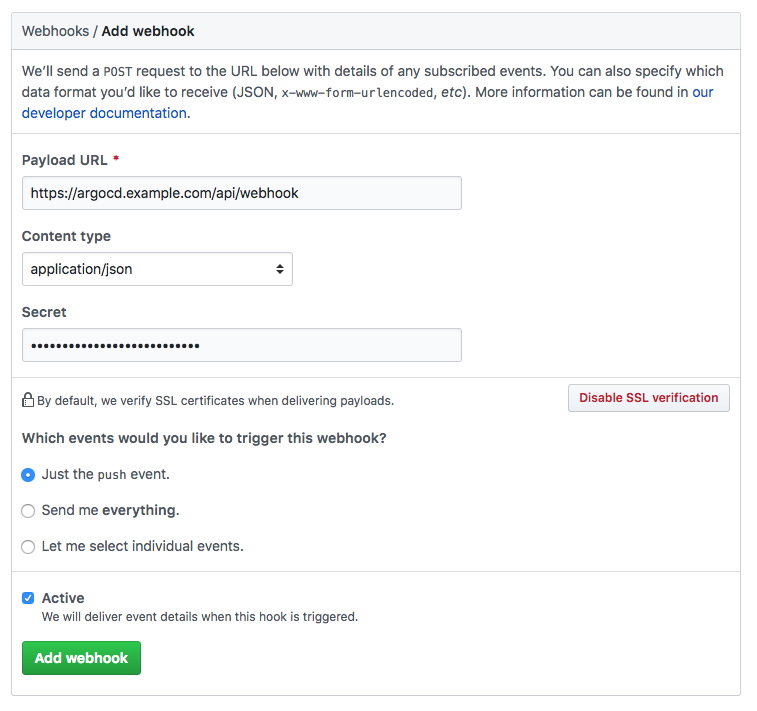
Note
When creating the webhook in GitHub, the "Content type" needs to be set to "application/json". The default value "application/x-www-form-urlencoded" is not supported by the library used to handle the hooks
2. Configure ApplicationSet with the webhook secret (Optional)
Configuring a webhook shared secret is optional, since ApplicationSet will still refresh applications generated by Git generators, even with unauthenticated webhook events. This is safe to do since the contents of webhook payloads are considered untrusted, and will only result in a refresh of the application (a process which already occurs at three-minute intervals). If ApplicationSet is publicly accessible, then configuring a webhook secret is recommended to prevent a DDoS attack.
In the argocd-secret Kubernetes secret, include the Git provider's webhook secret configured in step 1.
Edit the Argo CD Kubernetes secret:
kubectl edit secret argocd-secret -n argocd
TIP: for ease of entering secrets, Kubernetes supports inputting secrets in the stringData field,
which saves you the trouble of base64 encoding the values and copying it to the data field.
Simply copy the shared webhook secret created in step 1, to the corresponding
GitHub/GitLab/BitBucket key under the stringData field:
apiVersion: v1
kind: Secret
metadata:
  name: argocd-secret
  namespace: argocd
type: Opaque
data:
...

stringData:
  # github webhook secret
  webhook.github.secret: shhhh! it's a github secret

  # gitlab webhook secret
  webhook.gitlab.secret: shhhh! it's a gitlab secret
After saving, please restart the ApplicationSet pod for the changes to take effect.
Repository credentials for ApplicationSets
If your ApplicationSets uses a repository where you need credentials to be able to access it and if the
ApplicationSet project field is templated (i.e. the project field of the ApplicationSet contains {{ ... }}), you need to add the repository as a "non project scoped" repository.
- When doing that through the UI, set this to a blank value in the dropdown menu.
- When doing that through the CLI, make sure you DO NOT supply the parameter --project (argocd repo add docs)
- When doing that declaratively, make sure you DO NOT have project: defined under stringData: (complete yaml example)